
Hyperbaric oxygen therapy — HBOT — is one of the most frequently searched wellness and medical topics of the past decade, yet it remains widely misunderstood. Some sources present it as a miracle cure. Others dismiss it as pseudoscience. The truth, as is usually the case, lies in the evidence — and the evidence on HBOT is both substantial and nuanced.
This guide explains what HBOT actually is, what happens inside your body during a session, which conditions have the strongest scientific support, and how mild hyperbaric oxygen therapy — the type available for home and wellness use — differs from clinical-grade treatment.
No hype. No oversimplification. Just the science.
1. What Is HBOT? A Plain-Language Definition
Hyperbaric oxygen therapy is a medical and wellness treatment in which a person breathes high-concentration oxygen inside a pressurized chamber — at a pressure greater than normal atmospheric pressure (1.0 ATA at sea level).
The word hyperbaric simply means above normal pressure. Hyper = above. Baric = pressure. The therapy works by combining two variables simultaneously:
- Elevated atmospheric pressure — compressing the air (and oxygen) around and inside the body
- High oxygen concentration — typically 90–100%, compared to 21% in normal air
These two factors together produce a fundamentally different physiological state than breathing normal air — or even breathing pure oxygen at normal atmospheric pressure. Understanding why requires a brief look at how oxygen moves through your body.

2. The Physics: Why Pressure Changes Everything
Under normal conditions, your blood carries oxygen in two ways: bound to haemoglobin in red blood cells (roughly 97–98% of total oxygen), and dissolved directly in blood plasma (roughly 1–2%). The haemoglobin-bound route is efficient but has a ceiling — your haemoglobin can only carry so much oxygen regardless of how much you breathe.
This is where Henry's Law comes in. Henry's Law states that the amount of gas dissolved in a liquid is directly proportional to the pressure of that gas above the liquid. In practical terms: the higher the pressure and the higher the oxygen concentration, the more oxygen dissolves directly into your blood plasma.
This dissolved oxygen is the critical variable in HBOT. Unlike haemoglobin-bound oxygen, plasma-dissolved oxygen can reach tissues that haemoglobin cannot — areas with damaged, blocked, or absent capillaries. It can penetrate into hypoxic (oxygen-deprived) zones around wounds, tumours, and inflamed tissue that normal circulation cannot serve.
The numbers are striking:
| Condition | Atmospheric Pressure | O₂ Breathed | Dissolved O₂ in Plasma |
|---|---|---|---|
| Normal (sea level) | 1.0 ATA | 21% (air) | ~0.3 mL/dL |
| Mild HBOT — low | 1.3 ATA | ≥90% O₂ | ~2.5 mL/dL (approx. 8× normal) |
| Mild HBOT — standard | 1.5 ATA | ≥90% O₂ | ~3.0 mL/dL (approx. 10× normal) |
| Mild HBOT — high | 1.7 ATA | ≥90% O₂ | ~3.5 mL/dL (approx. 12× normal) |
| Clinical HBOT | 2.0–3.0 ATA | 100% O₂ | ~6.0–6.8 mL/dL (20+× normal) |
3. The Biology: Seven Mechanisms of Action
Elevated dissolved oxygen triggers a cascade of biological responses that go far beyond simply 'delivering more oxygen to tissues.' Researchers have now identified at least seven distinct mechanisms through which HBOT produces its therapeutic effects.
| Mechanism | What It Does |
|---|---|
| Hyperoxia | Oxygen saturation in blood plasma rises dramatically — tissues that are starved of O₂ receive a direct supply even when capillary circulation is compromised. |
| Angiogenesis | HBOT stimulates vascular endothelial growth factor (VEGF), triggering the growth of new blood vessels into hypoxic or damaged tissue. |
| Anti-inflammatory | Elevated dissolved O₂ suppresses NF-κB signalling, reducing the inflammatory cytokines that contribute to chronic pain and tissue damage. |
| Stem cell mobilisation | Repeated HBOT sessions increase circulating CD34+ stem cells by up to 800%, accelerating natural tissue repair and regeneration. |
| Antimicrobial | High-oxygen environments are bactericidal against anaerobic organisms and enhance the oxidative killing capacity of white blood cells. |
| Collagen synthesis | HBOT significantly increases fibroblast activity and collagen deposition, accelerating wound closure and connective tissue repair. |
| Mitochondrial function | Elevated oxygen levels support ATP production in mitochondria, improving cellular energy metabolism in fatigued or hypoxic tissues. |
4. What Conditions Does HBOT Treat?
Strong clinical evidence (approved indications)
- Diabetic lower extremity wounds — Reduced amputation rates by 3–4× in multiple RCTs
- Decompression sickness — Standard of care for divers with 'the bends'
- Arterial gas embolism — Emergency treatment following air entry into the bloodstream
- Carbon monoxide poisoning — Accelerates CO elimination and reduces neurological damage
- Chronic radiation tissue injury — Treats bone and soft tissue necrosis after radiotherapy
- Compromised skin grafts and flaps — Increases graft survival rates
- Crush injuries — Reduces compartment syndrome and preserves viable tissue
- Necrotizing soft tissue infections — Adjunct to surgery, reduces mortality
- Thermal burns — Adjunct treatment reducing infection and accelerating healing
Growing evidence (research-supported applications)
- Traumatic brain injury (TBI) and concussion — Multiple trials showing improved cognitive outcomes
- Post-COVID syndrome — Emerging RCT data showing improvements in brain fog, fatigue, and cognitive function
- Stroke rehabilitation — Improved neurological outcomes in sub-acute and chronic stroke
- Autism spectrum disorder — Some trials showing improvements in behaviour and social responsiveness
- Fibromyalgia & Lyme disease — RCT evidence showing significant pain and symptom reduction
- Age-related cognitive decline — Recent trials showing reversal of biological ageing markers

5. Mild HBOT vs. Clinical HBOT: What Is the Difference?
One of the most common points of confusion in the HBOT space is the distinction between mild hyperbaric oxygen therapy — the type used in home and wellness settings — and hard-chamber clinical HBOT used in hospital environments.
Clinical HBOT (hard chambers, hospitals): Conducted in rigid steel or acrylic chambers, typically at 2.0–3.0 ATA with 100% medical-grade oxygen. Sessions are conducted under medical supervision and are used for serious conditions including decompression sickness, arterial gas embolism, and non-healing diabetic wounds.
Mild HBOT (home chambers, wellness centers): Operates at 1.1–1.7 ATA with oxygen concentrations of 90–95%+ delivered by an integrated or attached oxygen generation system. Sessions are typically self-administered and used for wellness, recovery, performance, and adjunctive support of health goals.
6. What Happens During an HBOT Session?
- Entering the chamber — The door is sealed and the pressurization cycle begins. Depending on the model, this takes 5–25 minutes.
- Ear adjustment — As pressure rises, you may feel a sensation similar to ascending or descending in an aircraft. Swallowing, yawning, or gentle equalisation resolves this within moments.
- Pressurized session — Once target pressure is reached, you breathe normally inside the chamber. Oxygen concentration is maintained automatically. Most sessions last 60–90 minutes.
- Reading, resting, or relaxing — Many users read, listen to audio, or simply rest. The experience is calm and comfortable in well-designed chambers.
- Depressurization — The chamber slowly returns to ambient pressure over 5–15 minutes. The session ends and the door is opened.
7. How Many Sessions Are Needed?
The question of session frequency is one where a single answer does not fit all situations. One consistent finding across the research is that the benefits of HBOT are cumulative — they build across sessions rather than delivering their full effect in a single exposure. This is why home ownership of a mild hyperbaric chamber, enabling daily or near-daily use, often produces better outcomes than periodic clinic visits.
8. Is HBOT Safe? Understanding the Risks
When conducted within appropriate pressure parameters using properly certified equipment, HBOT has an excellent safety profile. Common minor side effects include ear pressure (resolved by equalising technique) or mild fatigue after initial sessions.
Contraindications: The following conditions require physician consultation before any HBOT protocol:
- Untreated pneumothorax (collapsed lung) — Absolute contraindication
- Active chemotherapy with certain oxygen-sensitising agents (e.g. bleomycin, doxorubicin)
- Recent ear surgery
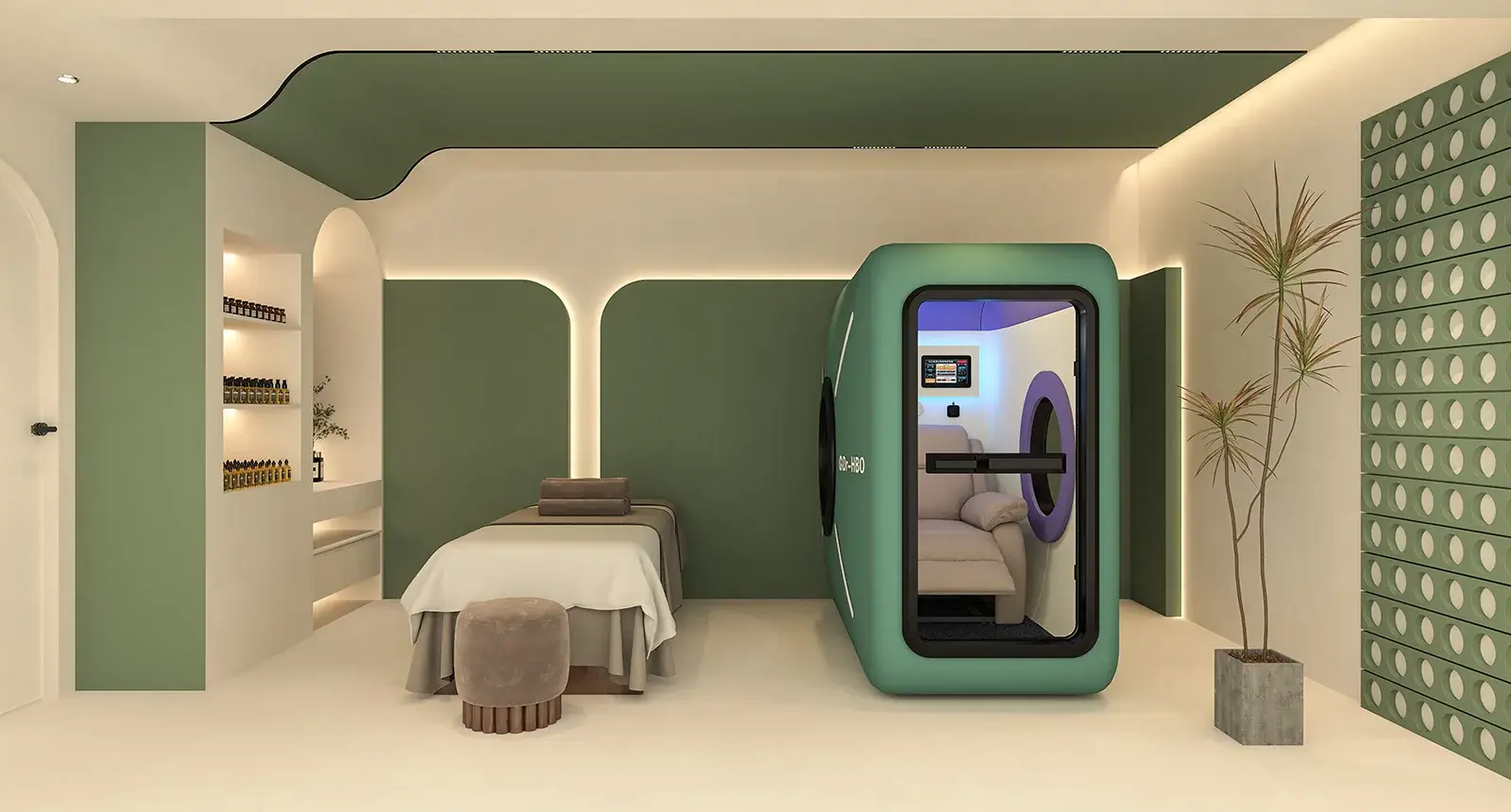
9. HBOT and HyperbaricO2Care: Mild Hyperbaric Chambers for Home and Clinical Use
HyperbaricO2Care manufactures a range of mild hyperbaric oxygen chambers designed to make the physiological benefits of HBOT accessible outside hospital environments — for home users, wellness centers, rehabilitation clinics, beauty salons, and high-altitude facilities.
Every HyperbaricO2Care chamber is built from aviation-grade steel with fully welded seams, includes an integrated oxygen generation system delivering ≥90–95.6% concentration, and ships with a safety specification that includes 4G emergency call, triple pressure relief valves, and real-time smoke detection as standard — not optional extras.
- AURA One — Single-person home chamber, 1.1–1.7 ATA, 3.3 m³, intelligent touchscreen
- NEPTUNE Flow — Portable chamber, 1.1–1.7 ATA, 4.3 m³ (largest single-person volume), ≥90% O₂
- LUMINA One — Beauty and spa-optimised chamber, 1.1–1.7 ATA, compact design
- TITAN Duo — Dual-person chamber for clinics and recovery centers, 1.1–1.7 ATA
- POLARIS Duo — Commercial-grade dual-person chamber for high-volume continuous operation
10. Frequently Asked Questions
Is HBOT the same as breathing pure oxygen at normal pressure?
No. Breathing 100% oxygen at sea level (1.0 ATA) saturates haemoglobin but does not significantly increase the dissolved oxygen in blood plasma. It is the combination of elevated pressure plus high oxygen concentration that triggers Henry's Law.
Does HBOT have anti-ageing effects?
There is emerging scientific evidence that it does — at a cellular level. A 2020 randomised controlled trial conducted at Tel Aviv University found that a structured 60-session HBOT protocol produced measurable increases in telomere length and reductions in senescent (ageing) cells. While this specific trial utilised clinical pressures (2.0 ATA) and specific fluctuation protocols, emerging consensus suggests that the biological pathways activated by mild HBOT aim to support similar cellular rejuvenation over consistent, long-term use.
Can I use HBOT if I have diabetes?
Diabetic patients are among those who benefit most from HBOT, particularly for wound healing and circulation support. However, HBOT can accelerate glucose metabolism, leading to a risk of hypoglycemia (low blood sugar) during or immediately after sessions. Diabetic users should monitor glucose closely and consult their physician before beginning a protocol.
Conclusion
HBOT is not a fringe therapy or a wellness fad. It is a physiologically grounded treatment with a robust body of clinical evidence, a clearly understood mechanism of action, and a safety profile that — at mild pressures — makes it accessible for home use without requiring medical supervision.
The science is clear: pressure and high-concentration oxygen together increase dissolved plasma oxygen dramatically, triggering a cascade of biological responses. Whether you are exploring HBOT for a specific health goal, athletic recovery, skin wellness, or general daily vitality, understanding the science is the best starting point for making an informed decision.