
A Beginner's Guide to Buying a Home Hyperbaric Oxygen Chamber (2026)
The idea of owning a hyperbaric oxygen chamber at home was, until recently, the exclusive territory of professional athletes, high-net-worth individuals, and medical facilities. That has changed significantly. Advances in hard-shell chamber engineering, integrated oxygen generation systems, and direct-from-manufacturer availability have made home hyperbaric oxygen therapy genuinely accessible to motivated individuals — without requiring a medical background, a clinical setting, or an enormous budget.
But buying a home hyperbaric oxygen chamber is still a significant decision. The market includes products at wildly different quality levels, safety specifications, and therapeutic outputs. A poorly informed purchase can result in a chamber that is unsafe, ineffective, or simply the wrong fit for your space and goals.
Therefore, this guide covers everything a first-time buyer needs to know — in plain language, with no industry jargon — before making that decision.
1. Why People Buy Home Hyperbaric Oxygen Chambers
The motivations behind home HBOT purchases are diverse. Understanding which category resonates with your situation helps clarify exactly what specification you need — and prevents you from overpaying for features irrelevant to your goals.
Recovery and athletic performance
Professional and amateur athletes have used hyperbaric oxygen therapy for decades. Increased dissolved oxygen in blood plasma accelerates the clearance of lactic acid, reduces inflammation in muscle tissue, and speeds connective tissue repair. For competitive athletes, triathletes, CrossFit enthusiasts, and anyone training intensely four or more times per week, a home chamber enables daily recovery sessions that would otherwise require costly clinic visits.
Chronic health conditions and wellness support
A significant proportion of home chamber buyers are individuals managing chronic conditions — post-COVID syndrome, fibromyalgia, Lyme disease, traumatic brain injury, or age-related cognitive decline — who have either experienced benefit from clinical HBOT sessions and want to continue treatment at home, or who are exploring mild HBOT as a complementary wellness tool alongside other therapies. Furthermore, the evidence base supporting HBOT for several of these conditions is substantial and growing.
Skin wellness and anti-ageing
Mild hyperbaric oxygen therapy at 1.1–1.7 ATA stimulates collagen synthesis, promotes cellular repair, and increases oxygen delivery to skin tissue. This has made home HBOT increasingly popular among individuals focused on skin health, anti-ageing protocols, and post-procedure recovery from aesthetic treatments. Beauty salons and spas have adopted hard chambers for exactly this reason — the same benefits are available to home users with the right equipment.
High-altitude environments
For people living or working at altitudes above 2,500–3,000 metres — including residents of the Andes, Tibetan Plateau, Ethiopian Highlands, and Colorado Rockies — a home hyperbaric chamber provides direct supplemental oxygen in an environment where ambient oxygen levels are chronically lower than at sea level. This is a practical health and performance tool, not just a wellness option.
General wellness and longevity
A growing category of buyers — particularly those in their 40s, 50s, and 60s — are purchasing home chambers as part of a broader longevity and health optimisation protocol. Supported by emerging research on HBOT’s effects on cellular senescence, telomere length, and mitochondrial function, these buyers are treating mild HBOT as a long-term investment in biological health maintenance.
2. Hard Chamber vs. Soft Chamber: Which Should You Buy?
As a first-time buyer, you will encounter both hard-shell and soft-shell chambers on the market. The choice between them is one of the most consequential decisions you will make — and the answer is almost always the same for buyers planning regular home use.
Hard chambers
Hard chambers are rigid steel or acrylic pressure vessels that maintain a fixed interior shape at operating pressure. These units deliver oxygen via an integrated generation system at 90–100% concentration, and operate stably at 1.1–1.7 ATA for mild HBOT. They include multiple safety systems — triple pressure relief valves, smoke detection, and emergency communication. With proper maintenance, a hard chamber can last 15–20 years. Furthermore, they require a dedicated space but minimal installation effort.
Soft chambers
Soft chambers are fabric inflatable enclosures that fill with compressed ambient air. Their design limits them to approximately 1.3 ATA maximum pressure.The internal atmosphere is air — approximately 21% oxygen — unless an external oxygen concentrator is used to supplement the breathing inlet. They are lightweight and portable. However, they have a lifespan of 3–5 years and require more frequent replacement. Safety systems are typically basic — a single pressure relief valve.
Soft chambers are appropriate for travel, temporary use, or as a very entry-level first step into HBOT. For anyone committing to regular sessions and expecting meaningful therapeutic results, a hard chamber delivers substantially better outcomes and represents better long-term value.
3. The Eight Questions Every First-Time Buyer Should Ask
Before making any purchase, ask every manufacturer or supplier these eight questions — and do not accept vague or evasive answers. A reputable manufacturer will answer all of them directly and in writing.
- What is the maximum operating pressure — and is it verified by independent testing?
Not just what the website claims. What pressure has the chamber been independently tested to? Ask for the pressure test certificate.
- How much oxygen concentration does the chamber deliver — inside the chamber, not at the inlet?
Internal atmosphere concentration matters. An oxygen concentrator feeding air into an imperfectly sealed chamber may claim 90% at the inlet but deliver 40% inside. Ask for data on internal concentration at operating pressure.
- What safety systems are included as standard — not as optional upgrades?
Triple pressure relief valves, smoke detection, emergency communication capability, and automatic depressurization on power failure should all be standard. If any of these are optional add-ons, treat that as a red flag.
- Which certifications does the chamber hold — and can you provide the actual documents?
The manufacturer must provide documents for CE, ISO, and equivalent certifications. Ask for the specific certificate — not a logo on a webpage.
- What is the warranty — and what does it cover?
Understand precisely what is covered: the pressure vessel, the compressor, the oxygen generation system, the control electronics. Ask what the process is for a warranty claim and how quickly the manufacturer responds.
- What is the chamber made from — specifically?
Aviation steel, marine-grade stainless, or ASME-rated pressure vessel steel are appropriate materials. Thin stainless sheet or unspecified ‘high-grade steel’ are not. Ask for the material specification and wall thickness.
- What after-sales support is available in my country?
Can the manufacturer provide installation guidance? Is there a local service agent? How are spare parts supplied? What is the typical lead time for parts if needed? For buyers outside the manufacturer’s home country, this question is particularly important.
- What is the actual delivered weight and installation requirement?
Some manufacturers quote shipping weight. Confirm the installed weight, the footprint, the door clearance required for delivery, and whether the chamber can be installed in an upstairs room (floor load rating matters for chambers over 500 kg).
4. Understanding Pressure and Oxygen: What the Numbers Mean
Pressure is measured in ATA — Atmospheres Absolute. 1.0 ATA is normal sea-level atmospheric pressure. 1.5 ATA means one-and-a-half times normal pressure. For mild HBOT, the therapeutic range is 1.1–1.7 ATA.
Why adjustable pressure matters
A first-time user should not begin at maximum pressure. Starting at 1.1–1.2 ATA and building gradually over several sessions allows the body to acclimatise — particularly the middle ear and sinuses. A chamber with adjustable pressure from 1.1 to 1.7 ATA gives you this flexibility. A chamber fixed at a single pressure does not.
As your protocol evolves and your goals become clearer, you may find that different pressure settings serve different purposes — lower settings for relaxation and sleep support, higher settings for recovery and cognitive enhancement. Adjustable pressure makes this possible.
Oxygen concentration: the most important number
This is the specification that most first-time buyers focus on least — and should focus on most. Breathing air at 1.5 ATA is very different from breathing 90%+ oxygen at 1.5 ATA. The dissolved oxygen in your blood plasma — the variable that drives the therapeutic mechanisms of HBOT — increases dramatically when oxygen concentration rises. At 90%+ oxygen and 1.5 ATA, dissolved plasma oxygen reaches approximately 15 times normal levels.
Confirm that the chamber you are considering delivers high-concentration oxygen throughout the interior atmosphere — not just at a mask or inlet point. An integrated oxygen generation system that saturates the entire chamber environment is the correct specification.
Note: These are wellness guidelines, not medical prescriptions. Always consult a physician for condition-specific protocols.
5. Space and Installation: What You Actually Need at Home
One of the most common surprises for first-time buyers is the space requirement. Before purchasing, take the time to plan exactly where the chamber will go and confirm that the space is suitable.
Floor area
A single-person hard chamber typically requires a floor area of approximately 2.5–3.5 metres in length and 1.2–1.5 metres in width, plus additional clearance on at least one end for the door to open fully. Add 0.5–1 metre on each side for comfortable access and air circulation around the compressor unit.
For a dual-person chamber — such as the TITAN Duo or POLARIS Duo — the floor area requirement increases accordingly. Always check the manufacturer’s installation guide for exact dimensions and clearance requirements.
Floor load rating
This is the most frequently overlooked requirement. A full-specification hard chamber can weigh 200–800 kg. Most domestic floors are rated for 150–200 kg per square metre. A chamber weighing 800 kg distributed over a 2 m² footprint represents a point load of 400 kg/m² — well above the typical domestic floor rating.
For upper-floor installation, have a structural engineer or qualified contractor assess the floor load capacity before purchasing. Ground-floor concrete slab installation is straightforward. Upper-floor timber or steel frame construction may require additional support — or may dictate choosing a lighter model such as the NEPTUNE Flow at 200 kg.
Ventilation
An oxygen-enriched environment requires adequate ventilation. Do not install a hyperbaric chamber in a sealed room with no airflow. A room with a door that can be left slightly open, or with passive ventilation, is sufficient for mild HBOT chambers operating at 1.1–1.7 ATA. Rooms where you conduct multiple daily sessions require active ventilation — particularly in commercial or clinical settings.
Power supply
Most mild hyperbaric chambers operate on standard single-phase domestic power (110V in the US, 220–240V in Europe, Australia, and most of Asia). Confirm the specific power requirement with the manufacturer before installation. We recommend a dedicated circuit to avoid tripping household breakers during operation.
Climate and temperature
The interior of a hyperbaric chamber increases in temperature during pressurization due to adiabatic heating. In warm climates — including the Middle East, Southeast Asia, and tropical regions — a chamber with an integrated air conditioning system is not a luxury feature but a practical necessity for comfortable sessions. Additionally, HyperbaricO2Care’s chambers include a Gree explosion-proof AC system specifically designed for oxygen-enriched environments.
6. Safety: What to Verify Before You Buy
Safety is the area where first-time buyers most often cut corners — typically because of price sensitivity. This is the wrong trade-off. A hyperbaric chamber is a pressurized vessel that you will spend hours inside, often alone. The safety specification is not a premium feature — it is the baseline requirement.
Pressure vessel integrity
The chamber must be constructed as a certified pressure vessel — not just a steel enclosure. This means the wall thickness, weld quality, material specification, and joint design have been engineered and tested to withstand the rated operating pressure with an appropriate safety factor. Ask for the pressure vessel test certificate. If the manufacturer cannot provide one, do not buy the chamber.
Pressure relief system
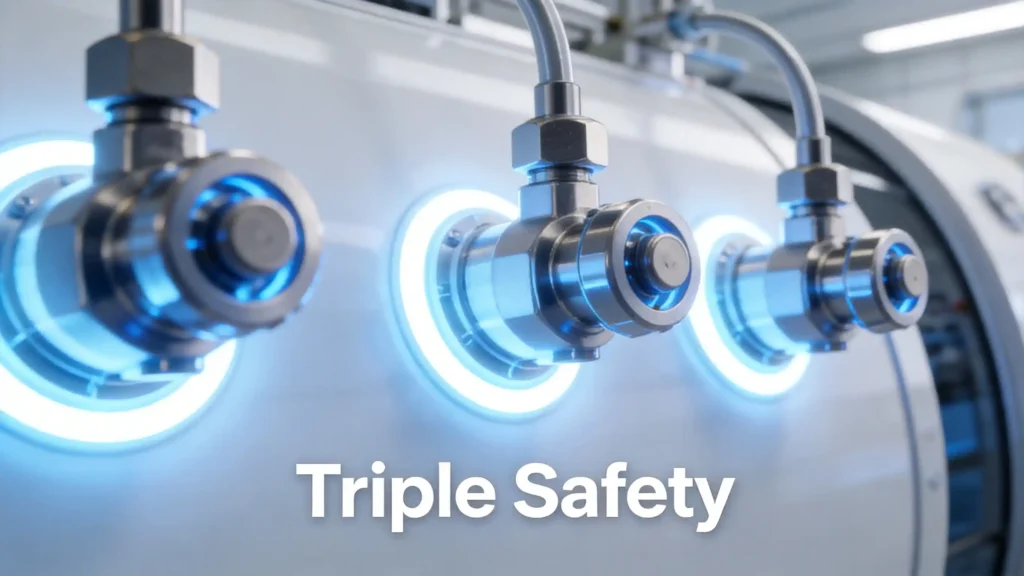
A single pressure relief valve is the minimum — and the minimum is not good enough for a chamber you will use daily at home. Look for triple pressure relief valves: one mechanical, one automatic electronic, and one manual. If any one of the three fails, the other two provide backup. This redundancy is the difference between a manageable fault and a dangerous situation.
Oxygen monitoring
The chamber should include real-time internal oxygen concentration monitoring. You should be able to see the actual oxygen percentage inside the chamber during your session — not just assume it based on the concentrator’s output rating.
Fire and smoke safety
Oxygen-enriched environments dramatically increase the flammability of materials that would barely catch fire under normal conditions. Synthetic clothing, certain plastics, and lubricants can all pose ignition risks in a high-oxygen atmosphere. A smoke detection system integrated into the chamber is an essential safety feature — not an optional one.
Emergency communication
You will be inside a sealed pressurized vessel, alone, for 60–90 minutes at a time. An emergency communication system — such as a 4G call capability that allows you to contact someone outside the chamber immediately — is a critical safety feature for solo home use. HyperbaricO2Care includes 4G emergency call as standard across its entire range.

7. The HyperbaricO2Care Range: Five Models for Every Home and Commercial Application
HyperbaricO2Care manufactures five hard-shell mild hyperbaric oxygen chambers covering every major home and commercial HBOT application. All five models share the same core engineering specification: aviation steel fully welded construction, integrated oxygen generation system, intelligent touchscreen control, triple pressure relief valves, real-time monitoring, smoke detection, and 4G emergency call — as standard, not as options.
AURA One — The home wellness benchmark
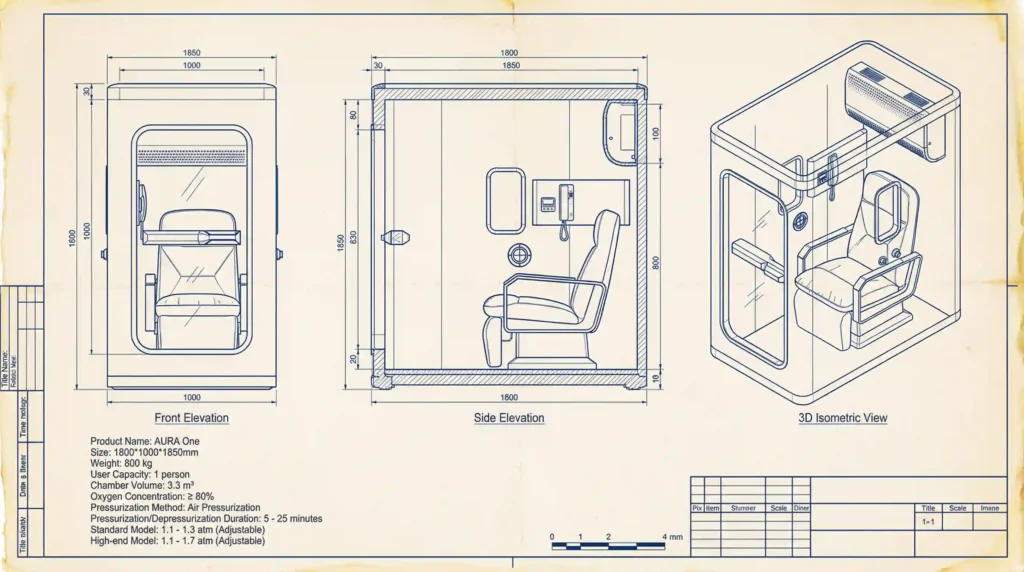
The AURA One is designed for individuals and families seeking a complete, daily-use mild hyperbaric oxygen chamber for home installation. At 1.1–1.7 ATA with ≥80% oxygen in a 3.3 m³ interior, it provides a comfortable, well-equipped environment for 60–90 minute daily sessions. The intelligent touchscreen monitors pressure, temperature, and oxygen concentration in real time. The 4G emergency call system provides peace of mind for solo home use.
NEPTUNE Flow — Portability and high oxygen output
The NEPTUNE Flow delivers the largest interior volume in the single-person range — 4.3 m³ — at a weight of 200 kg. The ≥90% oxygen concentration makes it the higher-output option for users prioritising maximum therapeutic benefit. Its lighter weight also makes it the preferred choice for buyers with upper-floor installation constraints or those needing to relocate the chamber periodically.
LUMINA One — Beauty and skin wellness
The LUMINA One is designed for buyers focused on skin health, collagen synthesis, and post-procedure recovery. Its compact form factor and ambient lighting system make it equally suited to a home bedroom installation or a professional spa environment. The ≥90% oxygen concentration delivers the cellular oxygen levels needed to support meaningful skin rejuvenation.
TITAN Duo — For households and small clinics
The TITAN Duo accommodates two users simultaneously. For households where two family members want to use the chamber regularly, shared sessions significantly improve the time efficiency of the investment. For small clinics and wellness centers adding HBOT to their service menu, the dual capacity handles moderate session volumes comfortably.
POLARIS Duo — Commercial grade, continuous operation
The POLARIS Duo is HyperbaricO2Care’s top-specification dual-person chamber — built for continuous operation in high-demand commercial environments. If you are purchasing for a wellness center, rehabilitation clinic, or luxury resort rather than purely personal home use, the POLARIS Duo’s enhanced thermal management and commercial-grade monitoring systems are the appropriate specification.
8. Frequently Asked Questions
Do I need a doctor's prescription to buy a home hyperbaric oxygen chamber?
How long does it take to see results from home HBOT?
Can multiple family members share a single chamber?
What clothing should I wear inside the chamber?
How do I know if the chamber is maintaining correct pressure during a session?
What happens if there is a power failure during a session?
Is home hyperbaric oxygen therapy covered by health insurance?
Conclusion
Buying a home hyperbaric oxygen chamber is not a small decision — but it is a straightforward one if you approach it with the right information. The fundamentals are consistent: choose a hard chamber over a soft chamber for regular use, prioritise oxygen concentration and pressure range over aesthetics, verify every safety specification before purchasing, plan your installation space carefully, and choose a manufacturer who can support you after the sale.
As a result, the market has matured enough that genuinely high-quality, well-specified home chambers are available at accessible price points — without the clinical complexity or infrastructure requirements of hospital-grade equipment. For buyers who do the research and ask the right questions, home HBOT is a well-evidenced, genuinely accessible tool for health, recovery, and longevity.
HyperbaricO2Care manufactures five hard-shell mild hyperbaric chambers specifically designed for home and commercial use — with full safety specification, direct-from-manufacturer pricing, and global after-sales support. If you are beginning your buyer journey, exploring the range is a natural starting point.